
Tutorial 4: Generative brain-to-text with NeuroQFormer#
This tutorial uses the packaged QFormer-based generator:
brain map or latent → NeuroQFormer → NeuroQwen → generated neuroscience text
The examples below use bundled network latents so the notebook is small and deterministic. A CUDA GPU is recommended; CPU works but can be slow because NeuroQwen is loaded for generation.
import os

os.environ.setdefault("USE_TF", "0")
os.environ.setdefault("USE_FLAX", "0")
os.environ.setdefault("TOKENIZERS_PARALLELISM", "false")

import numpy as np
import pandas as pd
import torch
import torch.nn.functional as F

import nibabel as nib
import matplotlib.pyplot as plt
import textwrap
from nilearn.image import resample_to_img, smooth_img, threshold_img
from nilearn.plotting import plot_stat_map

from neurovlm import NeuroVLM
from neurovlm.data import load_dataset, load_masker, load_latent
from neurovlm.models import load_model

device = "cuda" if torch.cuda.is_available() else "cpu"
nvlm = NeuroVLM(device=device)
masker = load_masker()
networks = load_dataset("networks")
2. Generation#
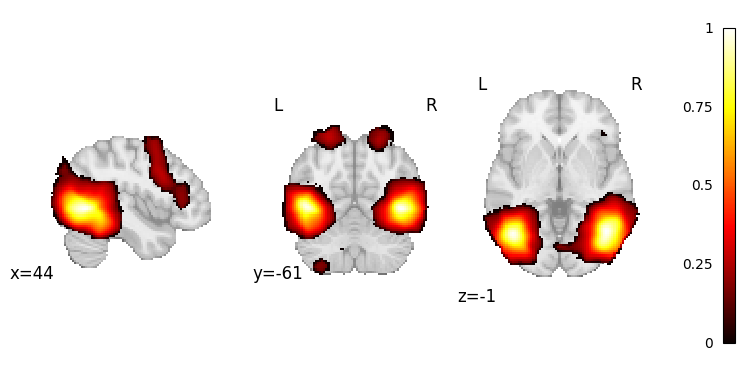
Predict network text description for the Laird Visual1 map.
Input image#
# Load image
X = networks["Laird"]["Visual1"]["array"]
affine = networks["Laird"]["Visual1"]["affine"]

# Use percentile threshold to binarize
X = X / X.max()
X[X > 1] = 1

# Plot
img_visual = nib.Nifti1Image(X, affine=affine)

plot_stat_map(img_visual, draw_cross=False, cmap='hot')
<nilearn.plotting.displays._slicers.OrthoSlicer at 0x7a583f76f020>
Generated text#
Text targets where trained with steering prefixes:
[NETWORK]: network-level generation[REGION]: individual region generation[FUNCTION]: funtional-level generation
These prefixes are controlled with the basis kwarg. If left as None, the LLM determines the basis in generation. The same brain latent can be decoded with different explicit basis prefixes. This is useful when you want a network-level label, a likely anatomical region, or a functional interpretation.
GENERATION_KWARGS = dict(
    max_new_tokens=140,
    num_beams=3,
    do_sample=False,
    seed=12345,
    projection_temp=0.035,
    repetition_penalty=1.18,
    no_repeat_ngram_size=4,
)

text = nvlm.brain(img_visual).to_text(head="qformer", **GENERATION_KWARGS)

for basis in ["network", "region", "function"]:
    text = nvlm.brain(img_visual).to_text(head="qformer", basis=basis, **GENERATION_KWARGS)
    print(text + "\n")
[NETWORK]Visual Network
The visual network includes primary visual cortex, occipital temporal cortex, fusiform gyrus, and occipital lobe. It is broadly associated with processing basic visual features such as shape, color, motion, and form. The network is often described as supporting the integration of visual information across the brain.

[REGION]Fusiform Gyrus
This region is broadly associated with the perception of visual identity, such as faces, objects, and scenes. It is often linked to the ability to identify and categorize visual forms. Its function is generally described as supporting the recognition of complex visual structures.

[FUNCTION]Visual Perception
Visual perception is the body's ability to interpret visual information. It is broadly associated with the occipital lobe, occipitotemporal cortex, superior temporal sulcus, and parietal cortex. This concept is often tied to the processing of motion, color, form, and spatial relationships.
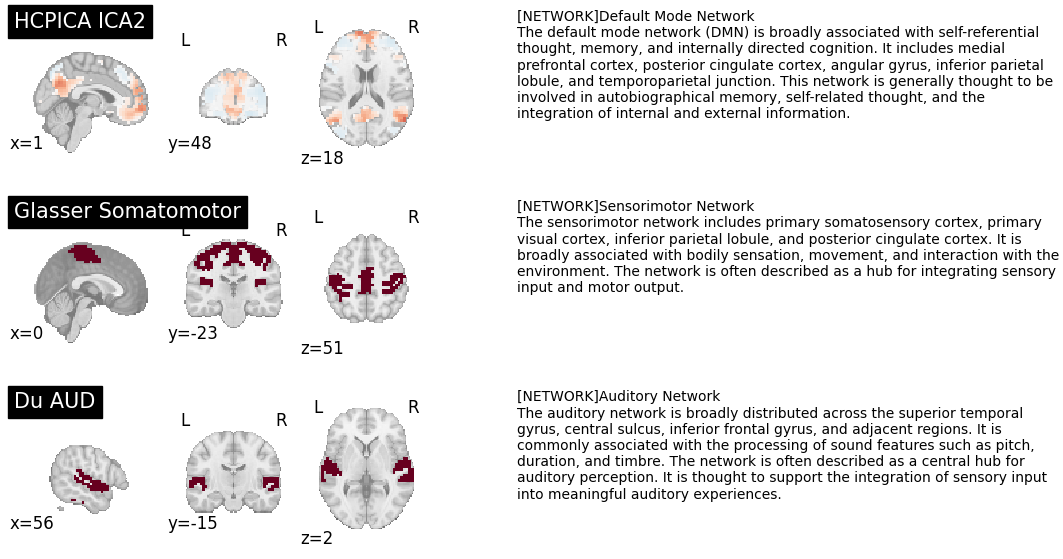
3. Generate multiple examples#
Batching keeps the model load cost fixed and returns one generated string per input latent.
# Prepare images
examples = [
    ("HCPICA", "ICA2"),
    ("Glasser", "Somatomotor"),
    ("Du", "AUD"),
]

images = []
image_arrays = []
for atlas, network in examples:
    # Load image
    X = networks[atlas][network]["array"]
    affine = networks[atlas][network]["affine"]

    # Rescale to (0, 1)
    X = X / X.max()

    # Resample to 4mm space
    img = nib.Nifti1Image(X, affine=affine)
    img = resample_to_img(img, masker.mask_img, interpolation="nearest")

    # Plot
    images.append(img)
    image_arrays.append(masker.transform(images[-1]))

image_arrays = np.vstack(image_arrays)
# Generate text
generated_text = nvlm.brain(image_arrays).to_text(head="qformer", **GENERATION_KWARGS)
fig, axes = plt.subplots(3, 2, figsize=(12, 7))

for ax_row, ex, img, text in zip(axes, examples, images, generated_text):
    plot_stat_map(img, axes=ax_row[0], title=f"{ex[0]} {ex[1]}", colorbar=False, draw_cross=False)
    ax_row[1].axis("off")
    ax_row[1].text(0, 1, text, va="top", wrap=True)
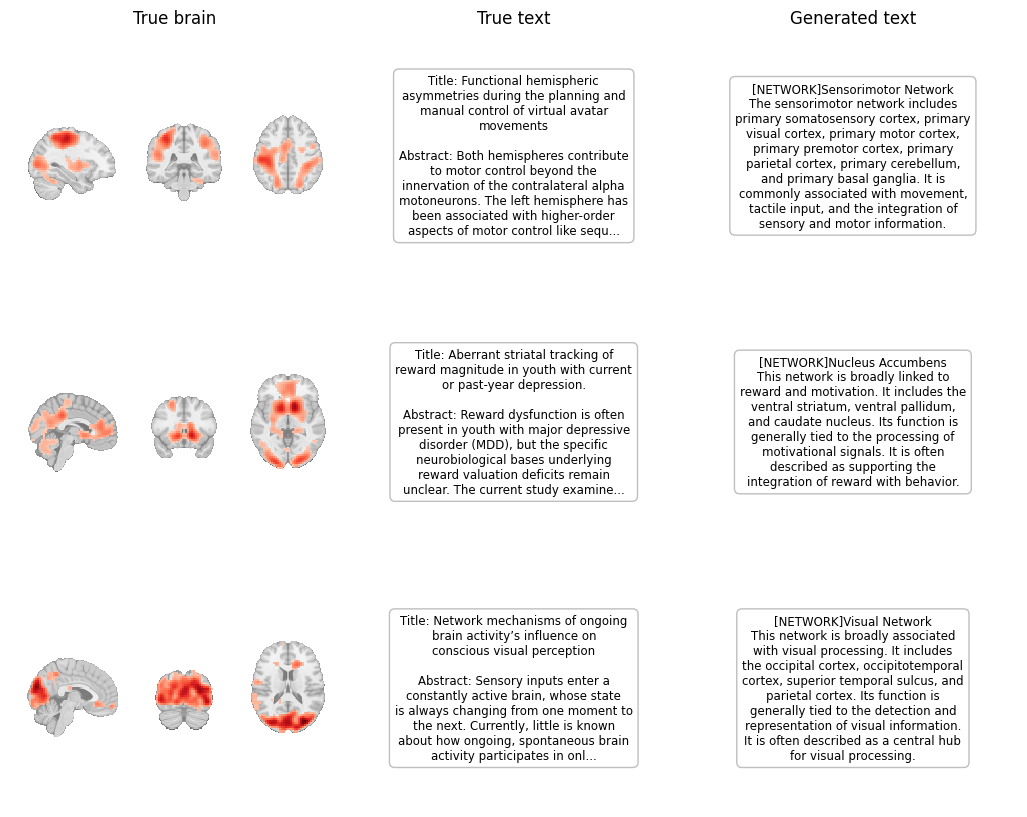
6. NeuroVault examples#
This example uses NeuroVault maps. For each search term, candidate papers are matched by title/abstract, then the contrastive image/text model selects the most similar image from those papers. The image column is smoothed and cluster-thresholded before plotting to make the spatial pattern readable.
NeuroVault studies have multiple images per study. Below uses the contrastive model to select the most similar image to the study text for demonstration.
# Load
neurovault_images = load_dataset("neurovault_images")
neurovault_meta = load_dataset("neurovault_images_meta").reset_index(drop=True)
neurovault_text = load_dataset("neurovault_text").reset_index(drop=True)
neurovault_text["text_row"] = neurovault_text.index
neurovault_text_by_doi = neurovault_text.set_index("doi", drop=False)

latent_neurovault_images = load_latent("neurovault_images")
latent_neurovault_text = load_latent("neurovault_text")

# Contrastive model
proj_head_image = load_model("proj_head_image_infonce").to(device).eval()
proj_head_text = load_model("proj_head_text_infonce").to(device).eval()
with torch.no_grad():
    image_latent = F.normalize(
        proj_head_image(latent_neurovault_images.to(device)), dim=1
    ).cpu()

    text_latent = F.normalize(
        proj_head_text(latent_neurovault_text.to(device)), dim=1
    ).cpu()

# Pair images to text
def _contains(series, search_str):
    return series.fillna("").astype(str).str.contains(search_str, case=False, na=False, regex=False)

def select_neurovault_image(search_str):

    papers = neurovault_text[
        _contains(neurovault_text["title"], search_str)
        | _contains(neurovault_text["abstract"], search_str)
    ].copy()
    images = neurovault_meta[neurovault_meta["doi"].isin(papers["doi"])].copy()
    if images.empty:
        raise ValueError(f"No NeuroVault paper/image match contains: {search_str!r}")

    image_idx = images.index.to_numpy(copy=True)
    text_idx = images["doi"].map(papers.set_index("doi")["text_row"]).astype(int).to_numpy(copy=True)
    scores = (image_latent[image_idx] * text_latent[text_idx]).sum(dim=1)
    image_idx = int(image_idx[int(scores.argmax())])

    return image_idx

search_terms = ["motor", "reward", "visual perception"]
neurovault_ids = [select_neurovault_image(term) for term in search_terms]
nv_raw_batch = neurovault_images[neurovault_ids]
# Cluster images
def cluster_threshold_vector(brain_vec, smoothing_fwhm=8):
    brain_vec = brain_vec.clamp_min(0)
    img = smooth_img(masker.inverse_transform(brain_vec), fwhm=smoothing_fwhm)
    img = threshold_img(
        img,
        "95%",
        cluster_threshold=100,
        two_sided=False,
        copy_header=True,
    )
    vec = torch.from_numpy(masker.transform(img)).float().squeeze(0)
    return vec, img

nv_thresholded = [cluster_threshold_vector(brain_vec) for brain_vec in nv_raw_batch]
nv_batch = torch.stack([vec for vec, _ in nv_thresholded])
nv_images = [img for _, img in nv_thresholded]
# Generate text from images
nv_generated = nvlm.brain(nv_batch).to_text(head="qformer", **GENERATION_KWARGS)
# Plot
def wrap_text(text, width=38):
    return "\n".join(textwrap.fill(line, width=width) for line in str(text).splitlines())

fig, axes = plt.subplots(3, 3, figsize=(13, 10), gridspec_kw={"wspace": 0.03, "hspace": 0.12})
text_box = dict(boxstyle="round,pad=0.45", facecolor="white", edgecolor="0.75")

for i, (ax_img, ax_true, ax_gen) in enumerate(axes):
    image_idx = neurovault_ids[i]
    map_row = neurovault_meta.iloc[image_idx]
    doi = map_row["doi"]
    row = neurovault_text_by_doi.loc[doi]
    if isinstance(row, pd.DataFrame):
        row = row.iloc[0]
    contrast = map_row["contrast_definition"]
    contrast = "not specified" if pd.isna(contrast) else contrast
    true_text = f"Title: {row['title']}\n\nAbstract: {row['abstract'][:200]}..."

    plot_stat_map(
        nv_images[i],
        axes=ax_img,
        colorbar=False,
        draw_cross=False,
        annotate=False,
        threshold=1e-6,
        cmap="Reds",
    )

    ax_true.axis("off")
    ax_gen.axis("off")
    ax_true.set(xlim=(0, 1), ylim=(0, 1))
    ax_gen.set(xlim=(0, 1), ylim=(0, 1))

    if i == 0:
        ax_img.set_title("True brain", pad=10)
        ax_true.set_title("True text", pad=10)
        ax_gen.set_title("Generated text", pad=10)

    ax_true.text(
        0.5, 0.5, wrap_text(true_text),
        ha="center", va="center", transform=ax_true.transAxes,
        fontsize=8.5, bbox=text_box,
    )

    ax_gen.text(
        0.5, 0.5, wrap_text(nv_generated[i]),
        ha="center", va="center", transform=ax_gen.transAxes,
        fontsize=8.5, bbox=text_box,
    )